Marketing Ops: The Only Job AI Can't \"Execute\" Away
AI writes copy and wires automations in minutes. But the person who connects pricing to CRM to dashboard is about to become the most secure job in marketing. Here's why, with a real system I built.
AI writes copy, builds landing pages, and configures automations in minutes. The execution layer is getting commoditized fast. That's not a prediction. It's already happening.
But the person who connects the pricing model to the CRM to the dashboard is about to become the most secure job in marketing.
Here's why, with a real system I built last month.
Before: The Problem
A restoration company I work with got leads from two forms: estimates and referrals. Before I touched anything, those leads landed in a group text thread. Half got lost. The other half sat unread for hours because the owner was on a job site with his hands full.
No assignment logic. No duplicate check. No record of who got contacted when. Just raw leads dumped into chaos and prayed someone acted on them.
This is what most small businesses look like under the hood. Not because they are lazy. Because the gap between "we need a system" and "we have a system that actually works" is massive. And the tools that promise to bridge it usually make it worse.
What I Built
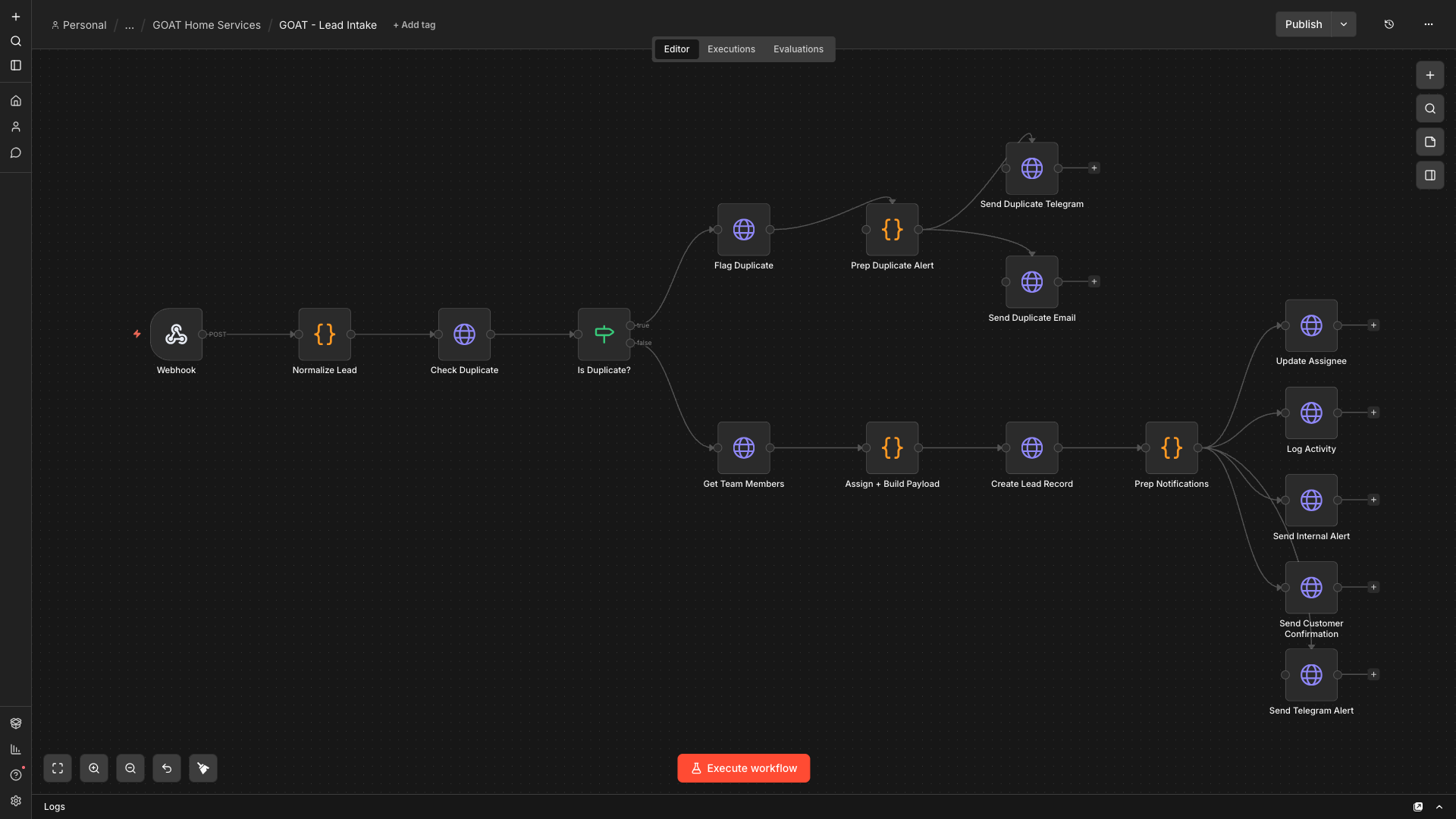
I built a 17-node n8n workflow that connects their estimate form to Airtable, checks for duplicates, round-robins assignment between three team members, sends a branded confirmation email via Resend, fires a Telegram alert, and logs the activity. All in under three seconds.
The execution isn't hard. AI could wire most of those nodes in a single prompt.
What AI can't do is decide that a referral form gets routed to the owner while an estimate form goes to the sales rotation. It can't tell you that the duplicate check is worthless without a fallback assignment rule. It doesn't know that the branded email header needs to match the paid campaign creative. And it definitely can't tell you that a lead marked "Emergency" should skip the round-robin and go straight to the on-call technician.
That system required one human decision: map the business rules before touching a single node.
The Architecture vs. Execution Gap
I see teams rushing to "AI-ify" their marketing ops. They're installing agents that promise autonomous execution without defining success. The result is faster chaos. More output. Less alignment.
The job isn't going away. It's shifting from execution to architecture.
Execution is wiring nodes. Architecture is deciding what the nodes should do before you wire them.
AI can execute. It cannot architect. Not because it lacks capability, but because architecture requires context about your business that no model has access to. Your pricing model. Your team's strengths. Your customer's pain points. The informal rules that only exist in the founder's head.
Good marketers get better at applying AI to the tactical work. Great marketers get better at building the logic that keeps the machine honest.
How to Start
If your team is building automations right now, the question isn't whether AI can do the work. It's whether someone in the room understands the business rules well enough to judge if the work is right.
Start here. Before you buy another tool or install another agent, write down three rules:
- What makes a lead "qualified" in your system? Not generically. Specifically. What fields, what values, what combination?
- Who gets what lead, and why? Is it round-robin? Is it by geography? By urgency? By relationship?
- What happens when the system disagrees with reality? If a lead comes in at 11 PM on a Saturday, does it wait until Monday or does it page someone?
If you can't answer those three questions, AI will build you a very fast, very expensive system that does the wrong thing consistently.
The Real Job Security
The most secure job in marketing isn't the person who knows the most tools. It's the person who knows which tools should talk to each other, what they should say, and what "done" looks like when the conversation is over.
That's architecture. And AI can't execute it away.
What's the single most fragile connection in your marketing stack? The one that breaks when two systems disagree on what a "qualified lead" means?
Download the workflow: Lead Intake Workflow JSON