The AI Lead Magnet That Qualifies While It Chats
How I built a RAG-powered conversational widget that replaces gated PDFs with real-time value exchange and scores leads implicitly based on what they ask.
Most lead magnets follow the same playbook: offer a PDF, gate it behind a form, hope someone reads it. The conversion rate on gated content has been declining for years. People are tired of downloading whitepapers they'll never open.
I built something different for an education company: a conversational widget that answers questions about their programs using RAG (retrieval-augmented generation) and quietly scores the lead based on what they ask. The value exchange is immediate. Ask a question, get a useful answer. No form required upfront. The scoring happens in the background.
This project sits at the intersection of two things I spend a lot of time on: building AI-powered marketing infrastructure and finding ways to make lead qualification less intrusive and more intelligent.
Why This Matters For Your Business
Most sites still gate their best content behind a form, which means the moment a prospect is most curious is the moment you ask them to give something up. That trade costs you conversions, and it hands you noisy data anyway. A form fill tells you someone was curious enough to type an email, not whether they're actually close to buying.
A conversational lead magnet flips that. The visitor gets a real answer immediately, and every question they ask is a stronger buying signal than any click ever was. Someone asking about pricing and start dates in the same conversation is a warmer lead than ten people who downloaded a PDF and never opened it again. Your sales team stops chasing volume and starts working a shorter list of people who've already told you, in their own words, that they're close.
The pattern generalizes past education. Any business selling something that takes explanation (a service, a high-consideration product, a subscription with real onboarding) has the same shape of problem: prospects have questions before they'll talk to a human, and the questions themselves are the best qualification data you'll ever get for free.
How It Works
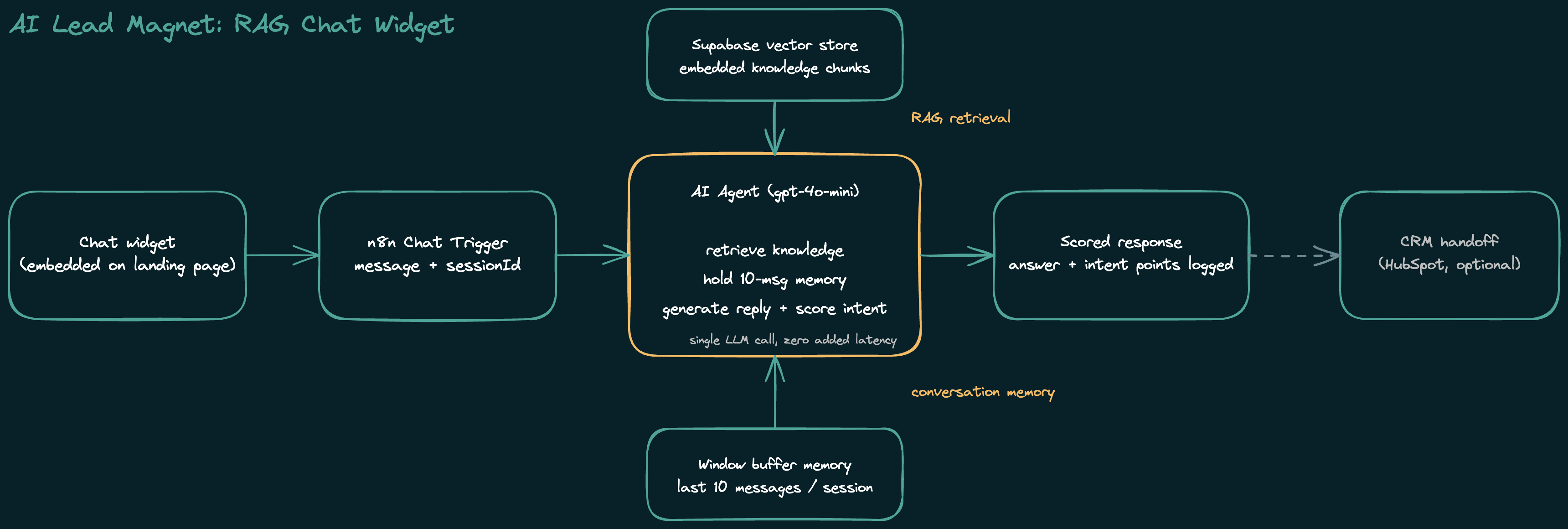
User types question in chat widget (embedded on landing page)
    |
    v
n8n Chat Trigger receives message + session ID
    |
    v
AI Agent node (gpt-4o-mini) with three sub-components:
    |-- Supabase Vector Store > Retrieve relevant knowledge chunks
    |-- Window Buffer Memory > Maintain 10-message conversation context
    +-- System prompt > Generate response + classify intent for scoring
    |
    v
Response sent to user
The architecture is intentionally simple. The n8n Chat Trigger receives messages from the embedded widget, then passes them to an AI Agent node powered by OpenAI's gpt-4o-mini. The agent has access to a Supabase-backed knowledge base tool for RAG retrieval and a Window Buffer Memory node that keeps the last 10 messages in context. If you're familiar with how I approach workflow automation with Activepieces, this follows the same philosophy: modular steps connected by a visual workflow engine.
What makes this design clean is that the scoring logic lives inside the agent's system prompt rather than as a separate processing step. The agent simultaneously generates a helpful response and classifies the user's intent level, all in a single LLM call. No additional nodes, no parallel branches, no added latency.
The RAG Knowledge Base
The Supabase vector store contains content chunked into semantic segments. For any high-consideration product, the knowledge base should cover the categories prospects actually ask about: how the offering works, what it costs, what the time commitment looks like, what outcomes to expect, how it compares to alternatives, and answers to the questions that come up most in sales conversations.
Each chunk is embedded using OpenAI's text-embedding-ada-002 model and stored with metadata tags (topic, program area, intent level) for filtered retrieval. The metadata tagging is what makes retrieval precise rather than just "semantically close." When someone asks about pricing, the system pulls pricing chunks specifically, not just content that happens to mention numbers.
This is the same RAG pattern I used in my automated job search pipeline, where vector retrieval powers dynamic cover letter generation. The principle is identical: store domain knowledge as embeddings, retrieve contextually, and generate responses grounded in real content rather than hallucinated answers.
Implicit Lead Scoring
This is where the project gets interesting from a marketing perspective. Traditional lead scoring requires explicit actions: form fills, page visits, email clicks. Each action gets a point value, and when the score crosses a threshold, the lead gets routed to sales. The problem is that those signals are noisy. Someone downloading a PDF might be a competitor doing research. Someone visiting a pricing page might be a current customer checking renewal rates.
Conversational scoring is different because what someone asks reveals intent more accurately than what they click. The scoring weights are baked directly into the agent's system prompt, classifying each question in real time:
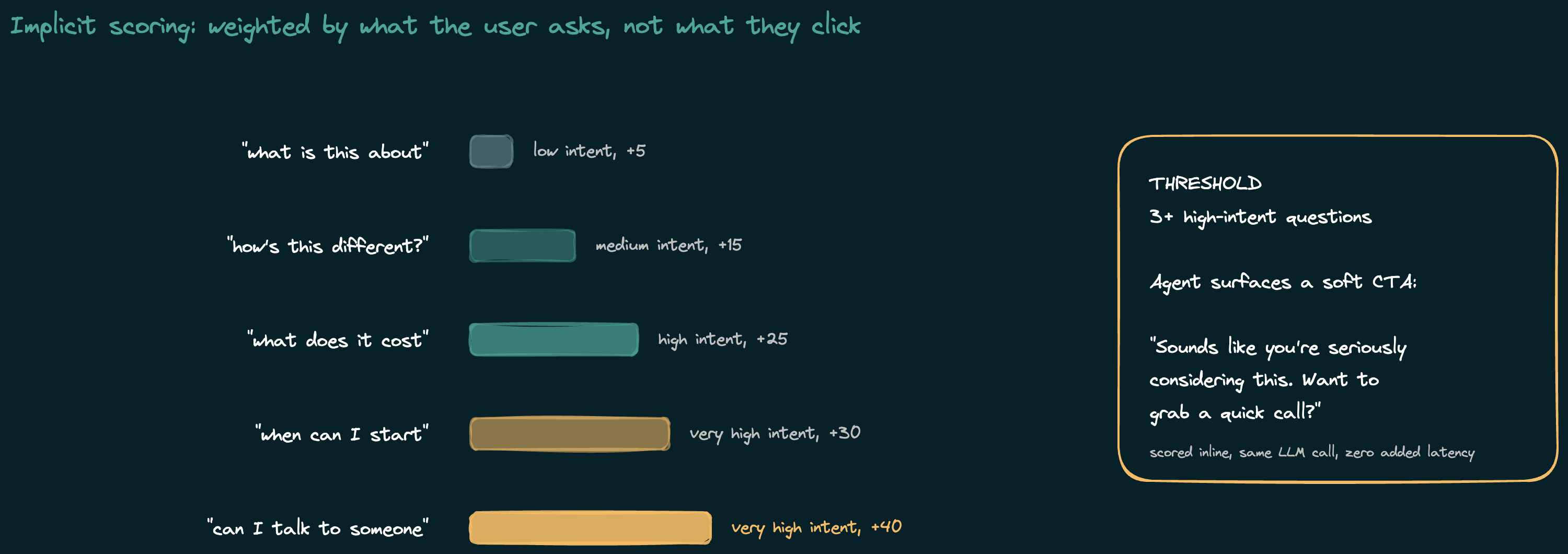
Very high intent: scheduling and start date questions (+30) and explicit requests to talk to someone (+40). These indicate someone ready to make a decision.
High intent: pricing questions (+25). Someone asking about cost is evaluating whether the program fits their budget, not just browsing.
Medium intent: comparison questions (+15), asking how this differs from alternatives. Active research, but not yet in decision mode.
Low intent: general exploratory questions (+5), like "what is this about" or "how does this work." Valuable for awareness, but not ready for sales.
When a user has asked three or more high-intent questions, the agent naturally surfaces a soft CTA: "It sounds like you're seriously considering this. Would you like to schedule a quick call with an advisor?" This feels natural because it is natural. The user has been asking detailed, specific questions. The system is reading the room, not interrupting it.
Because the scoring lives inside the system prompt rather than in a separate workflow branch, there's zero added latency. The agent classifies intent and generates the response in the same call. If the conversation data needs to flow downstream to HubSpot or another CRM, you can add a post-processing node after the agent, but the core scoring happens inline. For context on how I think about tracking and attribution across marketing tools, the same principles of clean data flow apply here.
The Chat Interface
The frontend is a lightweight HTML/CSS/JS widget that posts to the n8n webhook. It includes session management via sessionStorage, typing indicators, and error handling. The design is intentionally minimal. It looks like a help chat, not a sales bot. That distinction matters: people engage differently when they feel like they're getting help versus being sold to.
Key implementation detail: the widget sends a sessionId with every message so n8n can maintain conversation context across the exchange. The workflow's Window Buffer Memory node keys off this session ID to keep the last 10 messages in context for the OpenAI call. This means the conversation feels coherent. If someone asks "what about the schedule?" after asking about pricing, the system understands "the schedule" refers to the program they were just discussing, not a generic scheduling question.
Results
The widget drove meaningful improvements over the static PDF lead magnet it replaced. Average session length hit 3+ questions per user, compared to a single page view for the gated PDF. Users who engaged with the chat were significantly more likely to book a call than those who only viewed static content. The implicit scoring identified high-intent leads faster than traditional form-based scoring, giving the sales team a head start on outreach. And the sales team reported higher-quality conversations because leads arrived already educated on the program details that mattered to them.
The last point is worth emphasizing. When a prospect has already spent five minutes asking detailed questions about scheduling, prerequisites, and payment plans, the sales conversation starts at a fundamentally different place than "tell me about your program." The chatbot isn't replacing sales. It's doing the first ten minutes of discovery before the call even happens.
Takeaways
The gated PDF lead magnet is a relic of a marketing era when people had more patience and fewer options. Conversational interfaces flip the value exchange: instead of asking for information before providing value, you provide value first and let engagement signal intent.
If you're building something similar, the three things that matter most are knowledge base quality (garbage in, garbage out applies to RAG just as much as any other system), scoring calibration (start conservative and adjust thresholds based on actual sales feedback), and interface simplicity (the moment it feels like a chatbot, engagement drops).
For more on how I approach building reusable marketing systems and AI-powered automation infrastructure, explore some of my other writing.
If your business sells something that needs explaining before someone buys it, this same pattern, chat instead of a gate, scoring instead of a form, is worth a look. It's the kind of build I do through Whtnxt. Reach out below if you want to talk through what it would take for your funnel.
Edward Chalupa is a digital marketing specialist and founder of Whtnxt, a digital marketing and automation consultancy. Connect with him on LinkedIn or explore more at echalupa.com.