AI Overviews Took the Clicks. Track Your Citations.
AI Overviews cut organic clicks by 8.9%. Search Console cannot show you if your content is being cited. Here is the citation tracker I built to measure it.
In May, Google turned on AI Overviews in the US. Within weeks, the SEO subreddits were full of the same thread: traffic dropped, clicks fell, and a study showed an 8.9% decline in clicks when AI Overviews appear in results. The debate got louder from there. Some threads asked if SEO was dead. Others said diversify away from Google. Almost nobody asked the question that actually matters: is my content being cited in those answers?
That question is the whole game now. If an AI Overview answers a query your page used to rank for, the click is gone. But if your page is the source cited in that answer, you still won the query. You just cannot see it in Search Console. GSC reports clicks and impressions. It does not report citations. So I built the layer that measures it.
The measurement gap
An AI Overview is a citation surface, not a ranking. When Google composes an answer, it pulls from sources. That composition happens outside the normal SERP reporting. GSC will show you a position and zero clicks. It will not show you whether your domain appears as a reference in the generated answer.
That is a blind spot. You cannot optimize what you cannot measure, and right now the entire industry is arguing about AI Overviews with no instrument for the thing that matters. The same blind spot shows up elsewhere: my schema audit of 21 blog posts found zero author attribution in AI search, which means the retrieval systems were reading the pages but could not resolve who wrote them. Attribution is the first half of the problem. Citation tracking is the second.
What the tracker does
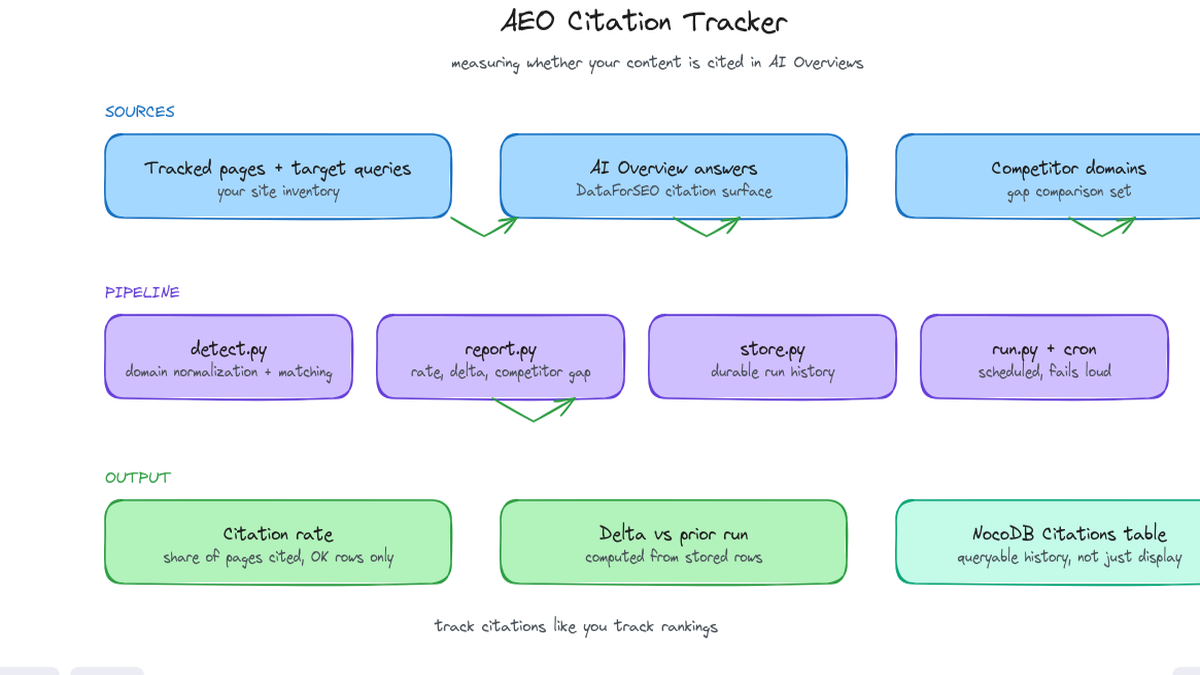
The AEO Citation Tracker runs on a schedule and produces a report with three numbers:
- Citation rate. The share of tracked pages that appear as sources in AI Overviews for their target queries.
- Delta. How that rate moved since the previous run.
- Competitor gap. Which competitors are being cited for the same queries, and how your count compares.
It writes results to a Citations table in NocoDB, so history accumulates and the trend is queryable, not just displayed. I built the connector set around the same Google surfaces I use everywhere else: Search Console and GA4 via MCP for the query inventory, and DataForSEO for the AI Overview citation surface.
The design decisions that mattered
The build was mostly boring plumbing, but four decisions carry the logic.
First, the denominator rule. Citation rate only counts rows with a successful check. Not Run and Error states are excluded. If a run fails halfway, the rate does not silently drop and produce a false alarm. This is the same principle behind my silent failure post-mortem: the dangerous failure is the one that looks successful.
Second, delta is computed from stored rows, not from memory. A rows_for_date function fetches the prior run's data so the report can compare like for like. Runs are independent; history is the source of truth.
Third, partial failures do not kill the run. The storage loop catches per-row failures and collects them instead of aborting the whole job. One bad row should not hide the other ninety-nine.
Fourth, the cron wrapper fails loudly. On failure it prints the full summary and exits non-zero, so the scheduler's exit trap fires. No silent success. The pattern is the same one I use for agent evaluation gates: the system tells you when it cannot guarantee the result.
What the data shows
The first signal is that citation rate is measurable at all. Most people in the AEO space are working from vibes. With this tracker, the question becomes concrete: how often does my domain show up as a source, how did that change this week, and who is beating me.
That is the same shape as ranking tracking, ten years later, for a different surface. The systems for the old surface are mature. The systems for this one barely exist, which is why the category is being defined right now. When I ran the first pass against a set of tracked queries, the AI Overview citation rate came back at 17.4%, with five competitor gaps and four new citations versus the prior run. Real numbers, not guesses.
The take
The AI Overview panic has the framing wrong. The click is not the only outcome of a query anymore. If your content is the source behind the answer, you capture the authority even when you do not capture the click. The problem is nobody could see that. Now the measurement exists.
Track citations like you track rankings. The data is there, and the competitors who figure this out first will hold the edge for as long as the rest of the industry argues about whether SEO is dead.
If you want the same visibility for your own site, the MCP development work at Whtnxt is where this class of system gets built, and content marketing is where the citations matter most. The measurement layer is the differentiator. Most of the market is still arguing about the problem. The people who instrument it will own the answer.